Thursday

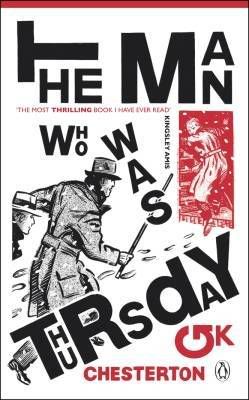
The Man Who Was Thursday


I finished reading "The Man Who Was Thursday". It's one of those books that I really thought I'd love. It was adventurous, absurd, and hilarious. I was really hoping for some grand theme of either peace and love, or total obliteration of mankind.

I really shouldn't say what happens but I can say that it didn't meet my expectations.

It was purchased for me by my boyfriend. It was recently released in the Penguin Great Books For Boys series. It's got a pretty damned cool cover.

The story is this: a poet and philosopher (also a police officer) infiltrates a secret society of anarchists, intent on blowing up the world in order to stop these plots. In the process, Syme (that's the character's name) picks up the most unlikely of allies and faces an onslaught of absurd realities until no-one knows who's who not to mention who is on who's side.

The plot twists are farcically absurd which made me keep going. I couldn't wait to see what would happen next! The characters are all dangerously similar in looks and demeanor. I can't tell you how many of them had pointy beards, though I remember one square cut one. I wouldn't have been surprised if it was all a delusion in Syme's mind, with himself being all of the twisted characters...though, that's not how it ends.

Saturday

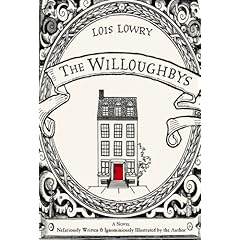
The Willoughbys


I finished "The Willoughbys" by Lois Lowry the other day. Because I'm one to judge a book by it's cover I thought, "This is the type of book I'd love!" The Gorey-esque cover illustration (also done by the author) promised to contain a very wry, dark tale in the vein of Lemony Snicket.

I was disappointed. A lot at first but as the story progressed, everything that I didn't like about it disappeared and it turned out to be rather lovely.

There are four Willoughby children: Tim, Barnaby A, Barnaby B, and Jane. Their parents don't like them. They don't like they're parents. In order to rid themselves of each other, the children suggest that their parents take a very dangerous vacation. The parents agree, hire a nanny and, without the children knowing, arrange for the sale of their house and head off.

In the meantime, the children don't treat each other very well, the oldest Tim is quite the bully. The twin Barnabys only have one sweater to share every other day. Jane is quite timid. They discover that an infant has been left on their doorstep and are charged with disposing of it. They leave it on the doorstep of a reclusive billionaire and hope to never hear of it again.

Turns out that the nanny who is hired is a rather good cook, has a sense of humor, would make a very decent parent, and tends to turn the story from outrageously depressing to quite pleasant. Her pleasantness changes the dispositions of the children too, which is great. Needless to say, their lives are quite quickly intertwined with the lives of the reclusive billionaire and the young orphaned infant.

Things turn out happily-ever-after. The story does tout itself as being and old fashioned tale (hence the orphans, the reclusive billionaire, the quirky nanny, etc). It's okay, though. I was really sick of the nastiness that had prevailed through the first half of the story. It was clever like Snicket. It was just depressing. It ended well, though, and still contained a little bit of the darkness that attracted me to it in the first place.

Tuesday

warm and fuzzy


I just read Cory Doctorow's Little Brother. If you don't know anything about Cory Doctorow look here. His webpage gives you tons of info, links to his book, how to donate a copy to your favorite teacher or librarian...
I'm not sure how I came across the donation program...perhaps it was on BoingBoing, maybe on Creative Commons...anyway, I came across the book (the e-book, actually), started reading it, started loving it (the ideas, anyway) and applied for a free copy for my library.

I wasn't sure anyone would care about a little branch library in Alaska. I was certain that anyone on the list had already contacted several people who would definitely buy books to donate to their cause. I was sure that I wouldn't receive a copy anytime soon.

I'd like to thank Dan B for his generous donation of Little Brother to my branch. May it be on the shelves as little as possible.

Now, my review. Being insufferably leftist, I tingled with excitement when I read a the description of Little Brother. Kids using open source/hacker/computer programming skills to fight back against the gross abuses of power of the Department of Homeland Security after a fictional terrorist attack in the not-so-distant future. Great.

Here's the story at-a-glance: 4 kids are in the wrong place at the wrong time and are held for questioning by the DHS, separated from one another, separated from their families, and threatened nearly into submission. 3 of the kids return to their homes unable to tell anyone of the abuses they suffered. So they start to fight back. They use secret networks to form connections and start a movement that is considered by the older generations (the DHS, their parents, their teachers, etc) to be sympathetic to the terrorists.

It's exciting and scary. It's funny and it's touching. It's filled with techno-babble. That I loved. I learned so much. It's also full of political stereo-types. That I didn't love so much but it was easy to ignore. Overall I could really relate to the characters. It touched all the my fears about the September 11th reactions (in the government and in society), it took me back to memories of my first love, and it rooted an incredibly adventurous tale in the real world.

Or close to real.

Sunday

BAM March--Craft

A craft is something that is developed over time, something that someone does for entertainment, for fun, and something that gives depth to an individual. This could be just about anything. Making music, knitting, cooking, reading, writing...all assuming that there is some skill involved. These skills may derive from practice, they may derive from some genetic brilliance. Either way, these skills and what we do with them define us as individuals. That being said, for my birthday at the beginning of the month, I bought myself The Autobiography of Edward Gibbon. I've read it before--twice, actually--but did not pay much attention to the first 1/3 of the text.

Edward Gibbon was an 18th century historian, considered a son of the enlightenment who spent a considerable amount of time and energy writing his epic Decline and Fall of the Roman Empire. He was incredibly well educated, well derived, and well-connected through his many family acquaintances. It is about the first 80 pages of his memoirs that he introduces his purpose, that he gives his family history, and that he discusses his education. These are the beginnings of the man.

Most historical texts offer, in the beginning, an explanation of purpose. This gives the reader some understanding of the motives of the author and a basis on which to analyze the facts based on the appearance of bias. For example, a biography commissioned by the subject him/herself, for the purpose of self-interest would be expected to be filled with half-truths in the interest of promoting the good characteristics while making excuses for the bad.

Gibbon's explanation for writing his memoirs is for his own entertainment. He eludes to vanity being the reason he records what he knows of his family's history saying, "In the investigation of past events, our curiosity is stimulated by the immediate or indirect reference to ourselves..."

He was born an ill child, spending many of his young years in the home, bedridden. But, when he was well enough to enter school, he excelled at most subjects. Now this is stated by him in some regards, others of which I am inferring based on what I have read and on my own education. One thing is for sure: Things have changed. Not only was Gibbon reading and translating Latin and Classical Greek from a very young age, he positively devoured anything that he could read. As a librarian, this fills me with both joy and sorrow. If only modern American education was so good. If only education anywhere was so good.

Clearly, if you've ever read or attempted to read this man's work, you would have a much better understanding of it's brilliance and of his skill by learning about the man himself.

Let me just mention that what I've described above is only about 1/3 of the book itself. He details his brief visit with Voltaire in Lausanne and what he learned there. He describes, quickly and quite poetically, his first love. He describes the circumstances around the publication of Decline and Fall. This is a life! This is a man!

There are very few people in this world today who's works, whose importance, and whose acquaintances can be measured equally to someone like Gibbon. It seems that the time for greatness has come and gone.

In comparison, mediocrity seems to rule the world today.
Saturday

All you champions...

ChaCha is looking for a champion...

a Semantic Taxonomy Champion, that is.

Check it out.

I've been playing on ChaCha for a bit today. It's a super-cool search engine that provides you with a Guide, a real person out there in cyberspace, to help you find exactly what you're looking for, thus eliminating all the garbage you get in your search results.

You have to register. But it's free.

Definitely worth checking out.

Thursday

Tuesday

Brideshead Revisited

This past two weeks I have been slowly devouring Brideshead Revisted by Evelyn Waugh. It's the most amusing and enjoyable book I've ever read.

The characters are absurd, yet realistic. The story is touching. The imagery is fantastic.

I can't stop talking about it. I never want to stop reading it. I haven't touched it in days. I'm savoring the end.